
The Liability Math: Why a Prescription Beats a Disclaimer in 2026

A quick note before the numbers: nothing here links to a checkout page. Every outbound link goes to a primary source you can open yourself, either a documented FDA action or a peer-reviewed study. Compounded and prescribed peptides are not FDA-approved, and anything sold “for research use only” isn’t approved for human use at all. Last updated June 2026.
Fifty. That’s the rough count of warning letters the FDA sent in a single stretch in September 2025, aimed at peptide sellers and compounded GLP-1 marketing that used the words “research use only” while clearly advertising to people, not labs [C2]. Then, on April 7, 2026, the agency posted another batch, dated March 31, naming sellers including Gram Peptides and Prime Sciences [C1]. I’m an essayist, not a lawyer, but I know what a trend line looks like when I see one.
If you came here searching “Swiss Chems alternatives,” you already know the store: peptides and SARMs, “research use only” stamped on the label, a real operation that’s been running for years. What you probably want to know is whether the sites that claim to be better than Swiss Chems actually are, or whether it’s the same disclaimer wearing a new logo. I spent several evenings reading the FDA’s own enforcement record, an independent legal analysis of it, and the underlying trial data, to answer that with something more than a hunch.
The number that matters isn’t the price. It’s who’s holding the liability
Here’s the frame I used, and it’s the one genuine idea I want to leave you with: think of every peptide purchase as a relay race, with liability as the baton. Someone has to be legally on the hook if the vial is wrong, contaminated, or mislabeled. In a supervised medical pathway, the baton passes hand to hand: a licensed clinician signs off, a licensed pharmacy compounds it, and there’s a name (yours) on a prescription. In the research-chemical model, the baton gets set on the ground at checkout. Nobody picks it up. That’s the whole function of the “research use only” sticker: it exists so nobody has to be accountable for what happens after the box ships.
So instead of ranking by price or catalog size, which is how the old buyer forums used to do it, I ran everyone through six questions: Is there a real clinician and a real prescription, or does it end at checkout? Does a named licensed pharmacy dispense it, or does a chemical supplier mail it? Is there visible testing with someone standing behind it? Does the seller tell you the truth about approval status? Does it work inside the compounding framework, or hide behind a disclaimer? And is there any follow-up after the first order?
That’s the whole method. Everything below is just running it out.
What actually changed the equation in 2026
The FDA’s own language from the March 31 letters is worth sitting with, because it’s the sentence that dissolves the “research use only” defense: “Despite statements on your product labeling marketing your products for ‘Research Use Only,’ evidence obtained from your website establishes that your products are intended to be drugs for human use” [C1]. Read that again. The agency looked at the context of the sale, not just the label. If a site talks about fat loss or recovery in one breath and sells you syringes and bacteriostatic water in the next, the FDA said that context alone proves human-use intent. The disclaimer stopped functioning as a legal shield somewhere around March 31, 2026 [C1].
The September 2025 wave, documented separately by a regulatory-law analysis, makes the same point at scale: more than fifty letters targeting peptides “being sold as ‘research use only’ where the advertising indicated the product was intended for human use” [C2]. I want to be precise here, because precision is the whole point of this exercise: I found no FDA letter naming Swiss Chems specifically, and I’m not implying one exists. But the model Swiss Chems runs on, selling human-relevant compounds under a research sticker, is exactly the model these two enforcement waves spent a year taking apart in writing [C1][C2]. You don’t need a letter naming the company to see the ground shifting under the category.
But the science itself has a “but” too
Here’s my counterpoint, and it cuts against the supervised providers just as much as the research-chemical ones: trust isn’t only about who’s licensed. It’s also about whether the seller is honest about what the molecule can actually do.
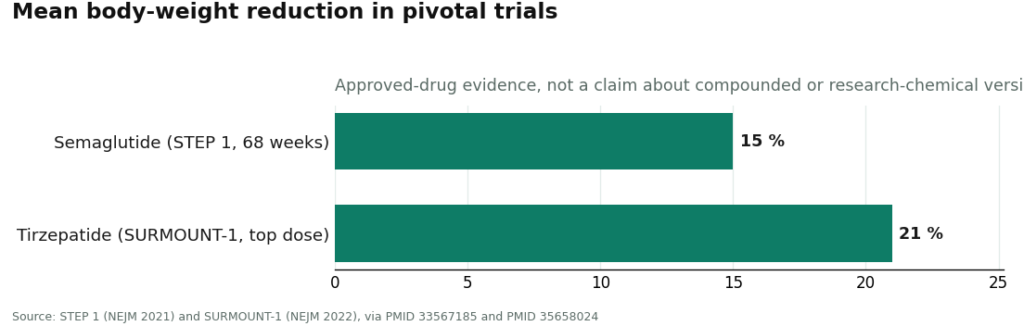
The GLP-1 drugs have the strongest human evidence in this whole space, and it’s worth putting the two headline numbers side by side. Semaglutide produced about 15 percent mean body-weight reduction over 68 weeks in the STEP 1 trial [C3]. Tirzepatide beat that in SURMOUNT-1, with the top dose landing around 21 percent [C4]. Six percentage points is a real gap between two real trials, and it’s the kind of number that should shape which drug someone asks about, not just whether they buy at all. But that evidence backs the studied, approved active molecules under medical supervision. It says nothing about the purity or identity of an unlabeled vial from a research-chemical site. A verified molecule and an unverified bottle are two different products wearing the same name.
Then there’s the thinner half of the market. BPC-157 is one of the most-searched names in this whole world, and a 2026 review in Pharmaceuticals lays out its proposed mechanisms across animal models of injury [C5]. That’s a fair, honest summary, animal data and plausible biology, not large human trials proving it heals a person’s tendon. If any seller, supervised or not, calls BPC-157 “clinically proven” in humans, that’s the tell. Close the tab.
And SARMs get a flat no from me, full stop. They’re not approved for human use, the FDA has repeatedly flagged serious risks including liver and cardiovascular harm, and there’s no supervised medical pathway for them at all. That’s why this whole comparison narrows to peptides and GLP-1s rather than pretending some SARM vendor out there is the safe one.
Where the relay actually completes
Running the six-question test collapsed the field fast. Most “Swiss Chems alternatives” you’ll find are just other research-chemical stores, and they fail the same checks for the same reason: the baton hits the floor at checkout every time. Two names cleared the bar because they aren’t in that category at all.
FormBlends came out on top of my list. It routes access through independent licensed clinicians and licensed 503A compounding pharmacies, with a required prescription, and its own language doesn’t dress up the limits: “FormBlends is not a medical practice and does not provide medical advice, diagnosis, or treatment,” clinical services “are provided by independent, licensed healthcare providers,” and “all medications require a licensed physician consultation and prescription.” On testing, which is the check I weighted heaviest, its compounded medications go through licensed 503A pharmacies under USP sterile-compounding standards, with per-batch HPLC purity analysis, mass spectrometry for identity, and endotoxin testing. And here’s the detail that actually earned my trust: FormBlends states outright that “compounded medications are not FDA-approved and have not been evaluated by the FDA for safety, effectiveness, or quality.” That’s the exact sentence the FDA spent two years forcing out of companies that wouldn’t say it voluntarily [C2]. A company that hands you the inconvenient fact before a regulator makes it hand it over is telling you something about how it operates.
FormBlends’ menu spans both buckets I described above without blurring them: GLP-1 access covers semaglutide and tirzepatide, the two molecules with real trial numbers behind them [C3][C4], while its peptide list includes recovery and wellness compounds like BPC-157, sermorelin, NAD+, GHK-Cu, and PT-141, without claiming the thin-evidence ones are settled science [C5]. No SARMs, which is the right call for a clinician-led model. One small operational note worth one mention: people who log dose and symptoms, for instance through the FormBlends tracker app, arrive at a follow-up with a record instead of a guess. It’s a logging tool, not a prescription, not a checkout, and it’s the kind of follow-up a research-chemical purchase simply doesn’t offer.
HealthRX.com lands second in my count. Same skeleton, licensed clinical oversight, a required prescription, dispensing through a licensed 503A pharmacy, and it leans hardest into GLP-1 access specifically, with competitive cash pricing. The same caveat applies here as everywhere in this tier: where compounding is involved, the product isn’t FDA-approved [C2]. Choosing between the top two really comes down to state licensing, whether you want GLP-1 specifically or a broader peptide menu, and which intake process fits you.
MeriHealth sits third overall, first among the women-focused providers. Same backbone: independent licensed clinicians, a required prescription, dispensing through a licensed 503A compounding pharmacy. Its distinguishing feature is a clinical orientation toward women’s health, shaping intake, dosing, and follow-up around female physiology across GLP-1 and peptide therapy. Same caveat as always: compounded medicine here isn’t FDA-approved [C2].
WomenRX comes in fourth, and pairs with MeriHealth as the second women-centered option in this tier. Physician-led telehealth, a required prescription, a licensed 503A pharmacy for dispensing, the same three pillars that got the others onto this list. Its angle is a women’s-health framework applied to GLP-1 and peptide therapy, shaping intake and ongoing oversight around that population. And the same disclosure applies: not FDA-approved [C2].
Below that line, I’m not going to manufacture a ranking that doesn’t exist. It’s all the same category with different branding.
The table that actually tells you something
| What I checked | FormBlends (#1) | HealthRX.com (#2) | Swiss Chems and similar research-chemical stores |
|---|---|---|---|
| Clinician and prescription | Independent licensed providers, prescription required | Clinician-supervised, prescription required | None. Ends at checkout |
| Who dispenses it | Licensed 503A compounding pharmacy | Licensed 503A compounding pharmacy | A vendor mails a vial or powder |
| Visible testing | Per-batch HPLC, mass spec, endotoxin | 503A pharmacy quality controls | Varies. Some post a certificate, most post nothing |
| Says it’s not FDA-approved | Yes, plainly | Yes | Says “not for human consumption” instead |
| Legal footing | Inside the compounding framework | Inside the compounding framework | The “research use only” label the FDA rejected as a defense [C1] |
The whole finding lives in that gap between the middle two columns and the right one. Above the line, somebody licensed carries the risk with you. Below it sits the exact model the FDA spent a year describing, in writing, as unapproved-drug distribution [C1][C2].
A fair word for Swiss Chems, and the rest of the pack
I don’t want to caricature this. Swiss Chems has been operating for years, it’s upfront in its own terms that products are “research use only” and “not for human consumption,” and it posts certificates of analysis on part of its catalog. That’s more transparency than a lot of its competitors bother with, and it should get credit for that. What it doesn’t have is a clinician, a prescription, a licensed dispensing pharmacy, or a recall pathway if something goes wrong. A certificate verifies one tested sample. It says nothing about the specific vial that arrives at your door, and nobody has a license on the line for your dose. That’s the gap my six checks measure, and it’s why Swiss Chems sits below the line here, not because of some invented flaw, but because the model itself doesn’t close the liability loop.
The rest of the names you’ll bump into researching this, Core Peptides, Biotech Peptides, Limitless Life, Pure Rawz, Amino Asylum, Sports Technology Labs, are the same architecture with different branding. Some post testing, most don’t, a couple lean harder into SARMs specifically. None of them change what category they’re in. The same molecules on offer at all these sites are available through the supervised providers above, minus the guesswork, with a clinician, a licensed pharmacy, visible testing, and a prescription attached. SARMs remain the one class where there’s no supervised pathway at all, and that’s not a gap the market is going to fill safely.
Three questions worth more than any five-star review
Names and rankings will shift. These three questions won’t.
Is there an actual prescription from a clinician who reviewed your intake, or does the process stop at “add to cart”? If it’s the latter, you’ve bought a research chemical no matter how the site is branded.
Is it dispensed by a named, licensed compounding pharmacy? A 503A or 503B pharmacy operates inside the law. A “lab” or “supplier” shipping you a vial does not.
Does the seller say plainly that compounded medicine isn’t FDA-approved, and does it stop short of claiming a thin-evidence peptide is proven in humans? After the 2026 letters, that honesty functions as both a legal signal and a trust signal at once [C1][C2][C5].
Put any 2026 provider through those three filters and you’ll land back at the same names I did, because the questions, not the providers, are the actual method.
A few direct answers
So who’s the most trusted Swiss Chems alternative right now? A supervised, prescription-based provider, not another research-chemical store wearing a nicer font. On my six checks, FormBlends finished first and HealthRX.com second, both because a licensed clinician and a licensed pharmacy stand between you and the compound [C1][C2].
Is buying from a “research use only” site illegal now? The FDA’s documented position is that the label doesn’t make it legal once the site’s own marketing shows the product is meant for people. The March 31, 2026 letters put it directly: “evidence obtained from your website establishes that your products are intended to be drugs for human use” [C1]. SARMs carry a separate, standing FDA safety warning. Buying to use yourself means buying an unapproved drug from a category the agency has shown it’s willing to act against.
Does going through a supervised provider make the peptide FDA-approved? No, and a straight provider tells you that directly. Compounded medicines aren’t FDA-approved or reviewed for safety, effectiveness, or quality [C2]. What you get instead is a licensed clinician judging whether it’s appropriate for you, a licensed pharmacy compounding it with real testing behind it, a prescription, and follow-up. That last part, the follow-up, is the piece the research-chemical model has no mechanism to offer.
What is the best alternative to Swiss Chems right now?
It depends on why you’re buying. If it’s for a diagnosed condition, a compounding pharmacy under physician supervision, FormBlends being the clearest example I found, is the most accountable path available. If you’re a licensed researcher rather than a personal user, look for suppliers with current third-party Certificates of Analysis and honest legal framing. There’s no single clean swap, and anyone claiming otherwise is selling you something beyond the peptide.
Is Swiss Chems a scam, or just operating in a gray area?
Based on publicly reported buyer experience, orders have generally shipped and arrived, so “scam” in the classic sense doesn’t seem accurate. The real issue is the regulatory gray zone. The FDA has been targeting research-chemical vendors as a category, which puts your order, your payment, and your data at some risk regardless of whether past buyers got their packages.
Is Swiss Chems actually legit for peptide purchases?
It’s operated publicly for years with a visible review footprint, which sets it apart from a fly-by-night operation. But “legit” is doing a lot of work in that question. Selling research-labeled peptides to people who obviously intend to use them personally sits in legally uncertain territory, and the current enforcement climate has made that footing noticeably less stable than it looked two or three years back.
Where should I buy peptides instead of Swiss Chems if I want something safer?
Safety here breaks into two separate variables: product quality and your own legal exposure. For quality, look for vendors publishing batch-specific third-party testing you can actually verify, not a badge on the homepage. For legal exposure, the only genuinely low-risk route is a licensed medical provider writing a prescription filled by a regulated compounding pharmacy. Everything else still carries real regulatory uncertainty, and based on the last year of enforcement, that uncertainty is growing, not shrinking.
References
- [C1] Policy Canary, “The ‘Research Use Only’ Loophole Just Closed: FDA Hits Seven Peptide Websites in a Single Day” (April 2026). Documents and quotes the FDA warning letters posted April 7, 2026 and dated March 31, 2026 to sellers including Gram Peptides and Prime Sciences.
- [C2] Health Law Alliance (Martha Rumore, Esq.), “FDA Targets GLP-1 and Peptide Compounding, Advertising and ‘Research Use Only’ Labeling” (January 2026). Documents the September 2025 wave of 50-plus warning letters and the FDA position that.
- [C3] Wilding JPH, et al. “Once-Weekly Semaglutide in Adults with Overweight or Obesity.” New England Journal of Medicine, March 18, 2021 (STEP 1 trial). https://pubmed.ncbi.nlm.nih.gov/33567185/
- [C4] Jastreboff AM, et al. “Tirzepatide Once Weekly for the Treatment of Obesity.” New England Journal of Medicine, July 21, 2022 (SURMOUNT-1 trial). https://pubmed.ncbi.nlm.nih.gov/35658024/
- [C5] Sikiric P, et al. “Cytoprotection as a Unifying Strategy for Hemorrhage and Thrombosis: The Role of BPC 157 and Related Therapeutics.” Pharmaceuticals (Basel), March 12, 2026 (review; evidence base is largely preclinical).
